Passive Investing
Understanding Index Funds & Passive Wealth Accumulation
An educational overview of low-cost broad market index funds and broad market portfolio strategies.
Read GuideExplore foundational asset classes and financial definitions for educational awareness.
Ownership equity units in publicly traded corporations representing partial company ownership and capital appreciation potential.
General Educational OverviewFixed-income debt instruments issued by corporations or governments paying fixed periodic interest yields over time.
General Educational OverviewProfessionally managed investment vehicles pooling capital from multiple investors to buy diversified securities portfolios.
General Educational OverviewExchange-Traded Funds tracking stock indices or commodity baskets that trade on stock exchanges throughout market hours.
General Educational OverviewThe practice of spreading investments across different asset classes, industries, and regions to manage volatility risk.
General Educational OverviewThe fundamental trade-off principle where higher potential financial returns typically carry increased risk of price fluctuations.
General Educational OverviewA logical 6-stage educational progression for understanding long-term wealth concepts.
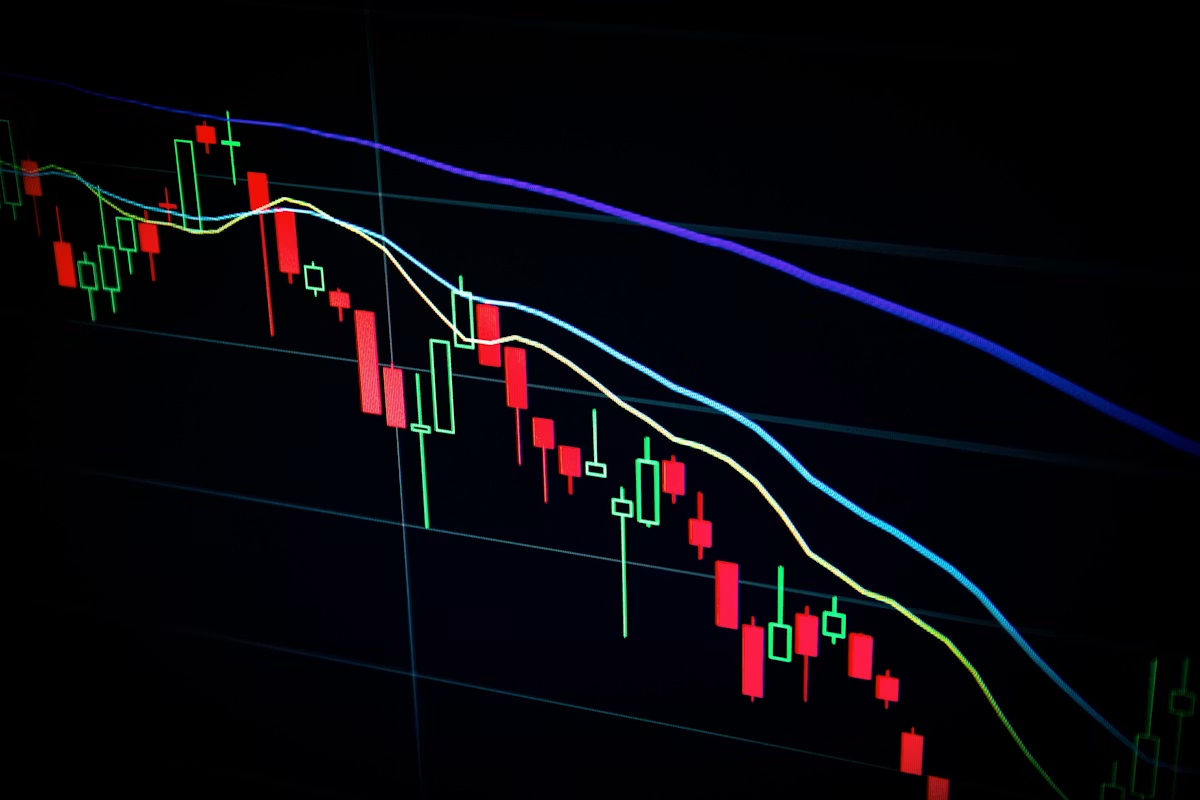
Understanding market volatility is central to building long-term financial awareness. Historically, investments offering higher potential returns come with greater potential fluctuations in principal value.
Cash equivalents and short-term debt offer stability but lower growth rates against inflation.
Stocks provide long-term capital appreciation potential accompanied by short-term price fluctuations.
Essential financial terms demystified for beginners building foundational literacy.
A resource with economic value that an individual or corporation owns or controls with the expectation of future benefit.
A collection of financial investments like stocks, bonds, commodities, cash, and cash equivalents.
A risk management strategy that mixes a wide variety of investments within a portfolio to limit exposure to any single asset.
The degree of variation of a trading price series over time, measuring the speed and magnitude of asset price movements.
The process in which an asset's earnings, from either capital gains or interest, are reinvested to generate additional earnings over time.
An investor's capacity and emotional willingness to endure market losses in exchange for potential long-term portfolio growth.
The total length of time that an investor expects to hold an investment before liquidating capital for specific goals.
A hypothetical portfolio of investment holdings representing a segment of the financial market, used as a benchmark (e.g. S&P 500).
Explore concepts surrounding long-term wealth building, market dynamics, and portfolio theory.
An educational overview of low-cost broad market index funds and broad market portfolio strategies.
Read Guide
Mathematical demonstrations showing how regular reinvestment of earnings grows exponentially over decades.
Read Guide
Understanding how combining stocks, fixed income, and real assets helps smooth overall portfolio swings.
Read GuideSubmit your questions regarding basic financial terminology, concepts, or request introductory reading materials.